
AnthonyB
Power Member
-
Joined
-
Last visited
Everything posted by AnthonyB
-
Without seeing I cannot be 100% but you sound like you will have more than enough exits and width for your occupancy and no travel distance issues.
-
Well BS9999 is out of the window as few Heritage buildings will meet all it's requirements, it's usually the English Heritage guidance along with the usual guides
-
Doors to the outside don't need self closers, internal doors often do. Those inside the flats don't anymore, but the front doors into internal common areas do and have done for a very long time - if your conversion is of a former house it may have been done not in compliance with Building Regulations if they have never been fitted. Concealed closers are allowed if to BSEN 1154 & correctly installed - whilst most aren't it is possible to get ones that are.
-
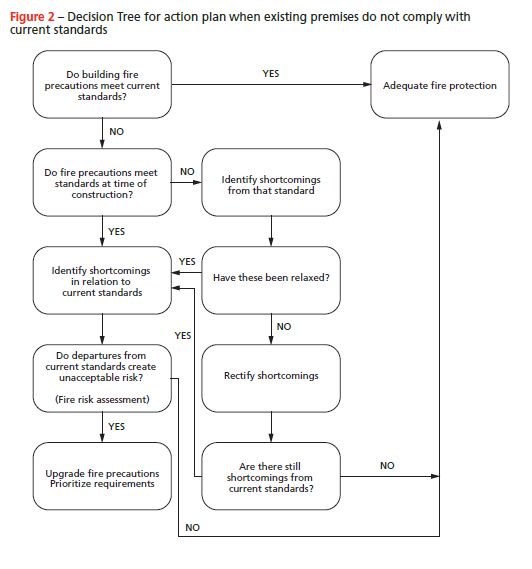
It doesn't even still meet the 1965 standards if the compartmentation has been breached and the original fire doors in poor order - breaching both the legal requirement to maintain in effective working order and to protect means of escape and mitigate the effects of fire. To determine if it's a legal requirement to modernise go through this tree:
 I''ve answered this duplicate post where it's first been posted.Powder would still be appropriate in your premises and still fully within the guidance in BS5306-8 on it's use. It is the best extinguisher for running fires and has a rapid knockdown. You do need to be aware of the damage potential though. Certain solvents are known as polar solvents and destroy the foam blanket of standard foam extinguishers so you would need to consult the Material Safety Data Sheets for the materials you use as this may rule out the use of foam (Polar solvent resistant foam extinguishers are available but very expensive) The Class B rating on water mist is so poor that the extinguishers cannot be officially marked as suitable for these fires and wouldn't suit your risks. If you don't have polar solvents then there is a Foam Mist extinguisher (https://www.firedepot.co.uk/firechief-multimist-6l-foam-mist-extinguisher). If you did use normal foam spray (not mist) then as it stands in the UK you would need CO2 for any electrical risks (most foams aren't marked for electrical fires here)- it's also good for minor spot fires if you do welding as it's non damaging.As an office the minimum requirement, both under Building Regulations, Government fire safety guidance and the commercial fire alarm standard BS5839-1 is a Category M fire alarm system with a control panel, alarm sounders and break glass manual call points. Only if desired for property protection (in which case the alarm would need monitoring) or if there is an unusual layout affecting means of escape (e.g. an Inner room) would detection be required and even then not in every room or stair. As a landlord providing a Category M system meets your obligations and the tenant's fit out and desire for property protection should determine if they need to or wish to add detection - in which case they should pay the cost of the additions which should be to the main system (not adding separate equipment). The cost of a proper fire alarm system can be reduced by specifying a twinwire system (such as Alarmsense) as instead of there having to be separate cabling for callpoints/detectors and for sounders you can put call points/detectors/sounders on the same cabling. Mains smoke alarms are for BS5839-6 systems in dwellings and are not intended for commercial premises (No call points, no fault monitoring, no fire resistant cabling, etc)It would be normal practice to protect the stair by underdrawing it to 30 minutes fire resistance using plasterboard or glass reinforced plasterboard of the required thickness (usually 12.5mm, the British Gypsum White Book gives suitable detail).How many floors? The full specifications can be found here: https://www.rla.org.uk/docs/LACORSFSguideApril62009.PDFThe legislation didn't cover social housing landlords as it wasn't considered necessary as they were deemed to be responsible and unlike the 'rogue' private sector not needing extra legislation. The Housing Act still applies and is enforced by the council via the housing health and safety rating system (HHSRS) - lack of suitable provision of smoke alarms would be a hazard enforceable under this system.The default approach in an FRA would be to ensure the cupboard had an FD30S door kept locked shut or be taken from use - but the legislation & guidance is risk based and in theory in a managed use communal area use as it is for non combustible items could be tolerable. I have risk assessed a set of flat blocks with a very active and involved tenants/owners management committee and tenants/owners that are similarly cooperative and was able to allow managed communal area use and some non fire resisting cupboard doors in the FRA with the support of local enforcement officers. Having said that such a situation is sadly an exception and in many blocks zero tolerance and 'belt & braces' precautions are the only realistic approach. So flexibility is possible, but it requires buy in from all residents to ensure it's workable.Even a new fire door does not have to have third party certification, so as long as they are inspected and maintained by a competent person and replaced if genuinely beyond repair then that should suffice.There's nothing stopping a fire exit being in normal access route from a fire safety point of view, usually it's a security issue where access is limited to just one normal door.p97-100 https://www.local.gov.uk/sites/default/files/documents/fire-safety-purpose-built-04b.pdfExactly my point. Technically very little is actually required in law, the FSO just sets broad functional requirements giving flexibility in how you comply and it's possible to safely and legitimately depart from the benchmarks such as those in British Standards, but it has to be justified and provide an adequate level of safety, so the default is to follow them - and I've seen to much wrong with uncommissioned equipment (and also those where they haven't been commissioned properly by a supposed competent firm) to justify not doing it. With no commissioning you can't tell if the unit is below weight on first service so will never be 100% sure of functionality (especially with CO2 where weight is the main way of telling if it's OK)Whilst the shutter is the more modern approach, there are plenty of existing premises where FD30 hatch doors are fitted, the 'keep fastened shut when not in use' approach is used.Is your flat door not a fire door at all or just an older one? In smaller blocks a risk appropriate tiered approach to the minimum standard door is advised in government guidance - although a current standard FD30s doorset is of course the best protection.But uncommissioned extinguishers are often incorrectly assembled, damaged and not serviced for over a year (no installation date) so it would be prudent to have them commissioned. The client is taking the full liability for failure to perform and having an adequate system of maintenance by not doing so.Powder still has it's place, some examples: - Spill & running fuel fires, where foam can struggle - Large fires requiring rapid knockdown - Low temperature areas - Class C fires where there are specialist staff to safely extinguish the flame and manage the resulting explosion risk - Multi risk areas where the secondary damage & personnel risks have been assessed as tolerable. Due to low cost it's still the most common multipurpose extinguisher for the home, although ABF Foam & Water Mist would also suit. Quantities of foam & CO2 extinguishers are based on risk, fire rating & travel distances - in some cases you might have a fire point of 2 x foam and 1 x CO2 Extinguishers that have passed the 35kV test are suitable for direct use on electrical fires up to 1000V - it's a peculiarly British thing that they avoid pointing this out and prefer to sell a CO2 as well. AFFF is an Irritant in concentrate (certain special blends are corrosive), but not a toxin or carcongenic. It's harmful to the aquatic environment and older blends were worse for the environment generally. Water (or water and wetting agent) is the best Class A medium as it cools and soaks, however powder can be effective if the right type: - BC Powder, usually an alkaline bicarbonate based medium is very limited on Class A as there is no cooling or smothering effect, just chemical inhibition, making it ineffective on anything but the smallest surface fire - ABC Powder, usually an acidic ammonium based medium has a greater effectiveness on Class A fires as it fluxes when heated and sticks to burning embers having a smothering effect as well as inhibition. There is still a risk of re-ignition in deep seated firesIt's far more than you need, but if you want the extra protection then why not!Looking at all the various questions on here for different premises it looks like you need to employ the services of an external competent person. Call centres usually have a higher density than offices and in older buildings, constructed based on office use and before call centres were a thing, will usually only have means of escape based on the lower office density and so a change of use results in overloading the capacity of the escape routes, both vertical & horizontal. I would first calculate the maximum capacity of your existing escape routes as this often is where the limiting factor comes in.Foam extinguishers are suitable for Class A fires as predominantly water based and in the UK all carry a Class A rating (in some cases a very impressive one allowing an extinguisher to cover twice the floor area of a plain water jet extinguisher). Whilst the use of plain water spray is preferred for environmental reasons where there is no Class B risk a large number of extinguisher companies still install foam sprayYou will also find most of those special user exemptions are now expired and the only remaining use of any note is on board aircraft and that expires soon so that no one will be allowed to use it. I suggest you also actually read the Equality Act.....?Is the main hall provided with smoke ventilation?