

Neil ashdown
Power Member
-
Joined
-
Last visited
Everything posted by Neil ashdown
-
Its likely to be intumescent strip, c.1988 would be right for this. Its purpose is to enhance the fire resistance performance at the gap between the edge of the door leaf and the reveal where it meets the door frame. https://www.ifsa.org.uk/
-
Is your Flat Entrance door-set timber or composite or metal? A photograph would be helpful.
-
Assuming the door leaf is timber-based and the wall is solid blockwork/masonry etc. If you work to the British Standard BS 8214: 2026 and document the installation work as to that Standard, you can evidence the compliance of the installation. So consult that document, page 32 for walls of solid blockwork/masonry. So from what you have said, the void left by removal of the old door frame is 10mm max depth by whatever the width of the frame was. Therefore you may install the new door frame to entirely cover the void with that void tightly packed with stone wool and then intumescent mastic at each end as detailed in BS 8214 above. Do not leave any gaps or voids at all. Make sure the new door frame extends over the void so that it's completely enclosed, is of the correct material and is above the minimum sectional dimensions as stated in the installation data sheet for the fire door leaf and is fixed with suitable fixing screws at the correct penetration and fixing centres. Again, all as detailed in the installation data sheet for the particular fire door leaf you are installing. However, MDF board or plywood, being rigid, would be easier to use in the instance. And in my view would be suitable instead of stone wool. All of the remaining installation work, including all hardware, seals, ironmongery, gap tolerances and trim allowances must meet the requirements of the installation data sheet for the particular fire door leaf you are installing. So that you can be compliant, if in doubt consult a fire door specialist.
-
Yes, its possible but alternatively you could have a fire door custom-made, from a certificated door blank, to fit the existing door frame. Either way, my advice would be to seek expert assistance to make sure everything complies with the relevant standards and regulations.
-
In the fire door sector, doors are currently tested to the Standards BS 476 part 22 and/or BS EN 1634-1. BS 476 is to be withdrawn from Approved Document B of the building regulations in September 2029 in respect of fire doors. In the tests above, doors are tested for integrity without smoke seals fitted. Intumescent seals are fitted but failure at the gap between the door leaf edge and the door frame is a common reason for the door not to perform as intended in the test. Therefore, in most cases the maximum door to frame gap is 4mm. In tests before the days of intumescent seals, the 3mm gap was more critical and failure at the gap between the door edge and door frame was more common. That's why doors were known as Fire Check rather than Fire Resisting. Anthony has earlier made reference to the1971 investigation into fire door performance, its an enlightening read so here's the link https://publications.iafss.org/publications/frn/855/-1/view/frn_855.pdf In the case of restricted spread of smoke at ambient temperature, smoke under pressure is forced through the gap between the door leaf and the rebate stop and then through the gap between the edge of the door leaf and the door frame. This is why propriety smoke seals are availble to fit to the rebate stop of the door frame as well as combined with the intumescent seal for sealing of the gap between the edge of the door leaf and the door frame. So, in a nutshell - the 4mm gap is primarily about satisfying the requirement for a successful result in a fire resistance performance test in a furnace. In practice the smaller the gap, then the better performance in terms of smoke spread. For better performance, install smoke seals that seal the gap.
-
If the door has BM TRADA certification it should have a circular plastic plug fitted to its hanging stile. https://www.google.com/search?q=bm+trada+plug+number&rlz=1C1GCEA_enGB1159GB1159&oq=bm+trada+plug+number&gs_lcrp=EgZjaHJvbWUyBggAEEUYOTIHCAEQIRiPAtIBCTEzODA0ajBqN6gCALACAA&sourceid=chrome&source=chrome.ob&ie=UTF-8 There will be a fir tree shape within the centre of the plug and a number will be moulded into that tree part. Quote that number to BM TRADA and they should be able to provide you with the contact details for the door manufacturer. You can then contact their technical dept for the information you need. But, generally speaking yes. A timber-based fire door with intumescent seals will generally require a 12mm thick rebate stop at the head and jambs of the door frame.

-
It is not possible to assess a door as a Nominal Fire Door by thickness alone. If the Fire Risk Assessor or indeed the RP has a good knowledge of fire doors, timber doors and joinery, they may well be competent to assess timber-based fire doors and make appropriate decisions about them. Clearly, the more knowledge and experience they have - the better outcome you would expect. When choosing fire door installers, maintenance & repairs contractors and inspectors etc you should always carry out due diligence about their credentials before engaging them. Membership of a Third Party Certification scheme could be a sign of competence but is no guarantee.
-
Under the Regulatory Reform (Fire Safety) Order 2005 the Responsible Person must carry out a suitable and sufficient Fire Risk Assessment. They must keep relevant persons safe by managing fire safety risks and implement preventative and protective measures. Under Article 18 of the RR(FS)O the Responsible Person should engage one or more Competent Persons to assist them in their duties as necessary. The RR(FS)O describes the Competent Person as somebody that has sufficient training and experience or knowledge and other quailities to be able to properly assist in undertaking proctective and preventive measures. Where an employee and where an owner or employer has sufficient competence they may carry out the Fire Risk Assessment to the extent that they have the necessary competence. The fire doors should be part of that fire risk assessment and the person assessing them should be able to show they have the necessary competence, but that does not necessarilly mean they must have specific qualifications relating to fire doors. https://www.legislation.gov.uk/uksi/2005/1541/article/18
-
"Whilst I agree that ADB calls for a FD20 door". It was the restricted smoke spread requirement that struck me, notwithstanding that self-closing is not a requirement.
-
Is this a single family dwelling house? Why has FD30(s) been specified by "Council Housing" - rather than FD20? And are the Regs being applied retrospectively? Approved Document B Table C https://assets.publishing.service.gov.uk/media/67d2bb074702aacd2251cb94/Approved_Document_B_volume_1_Dwellings_2019_edition_incorporating_2020_2022_and_2025_amendments_collated_with_2026_and_2029_amendments.pdf
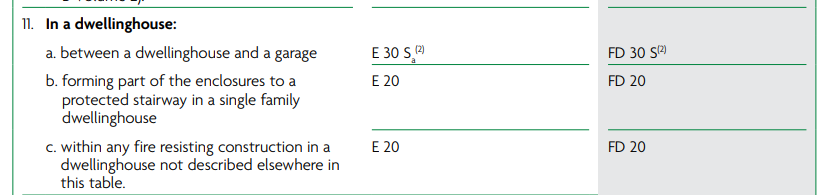
-
In order to comply with the fire door manufacturer's evidence of fire resistance performance (and therefore BS 8214: 2026) the door framing sectional dimensions* must 'continuously' be at least that specified by the installation instructions or certification data sheet for the door leaf. Therefore, the door frame should not be interrupted at any point. *commonly 32mm thick by 70mm wide as a minimum, but check the door leaf installation data.
-
"I hate to be argumentative, but BS 8214: 2016 relates to modern fire doors" No problem at all with that but, the point is that BS 8214: 2016 in the context of the 2mm to 4mm gaps, refers to doors being subject to the BS 476 Pt 22 or BS EN 1634-1 fire resistance performance tests. Its not that the doors are modern. Old doors and new doors are both made from timber-based materials and fire conditions in reality might not follow the same fire curve as the standard fire resistance performance tests.
-
As Mike said, the door leaf edge to door frame gaps are specified by the door leaf manufacturer and based on evidence from fire resistance peformance tests to BS 476 Part 22 and BS EN 1634-1. Commonly, the gap is 4mm maximum for timber-based fire doors. BS 8214: 2016 section 9.5.2 notes that failure of fire resisting doors under fire performance test is often due to burn through at the gap between the door leaf edge and the door frame. A typical gap for good fire performance is between 2mm and 4mm. There is no guidance, as far as I am aware, that suggests the gaps can be larger for older fire doors already installed in the built environment. Although many existing fire doors do have gaps outside the recommended 2mm to 4mm tolerance. UK Gov guidance may be useful for example at https://www.gov.uk/government/publications/fire-safety-england-regulations-2022/fact-sheet-fire-doors-regulation-10 and https://www.gov.uk/government/publications/making-your-small-block-of-flats-safe-from-fire The Responsible Person has a duty to make sure the fire doors are capable of providing adequate protection.
-
So it depends whether you are inspecting doors profesionally, in which case you should use gauges calibrated for accuracy. If you are not acting in a professional capacity, choose the one you are most comfortable with.
-
"I wondered if anyone else on this forum had come across this type of situation or could give clear guidance on when a fire door can be repaired rather than replaced?" A competent fire door specialist would be able to advise on this, but where the managing agent has already engaged a Fire Risk Assessor and a Fire Door Inspector they might not be willing to get a second opinion. But yes, Mike is correct there is no requirement for existing fire doors to meet the latest Building Regulations and Fire Door Standards. Options for remedial works and replacements require careful consideration before embarking on the works.
-
The Intumescent Fire Seals Association recommend that no more that five coats of oil based paint should be applied over intumescent edge seals. But none on smoke seals due to the detrimental effect of any paints to the brush/blade. Contact ifsa.org.uk for information.
-
Before the use of intumescent edge seals fire door tests were carried out to early versions of the BS476 test. The test preceeding the 1987 Part 22 test, we still use today, was BS 476 Part 8 of 1972 and door leaf edge to door frame gaps were 3mm without using intumescent edge seals. There has never been an absolute requirement for a 3mm (or indeed 4mm max gap) but test results have been successful using that gap on a first principles basis and guidance in BS 4787 'Internal & External Wood Doorsets' Part 1 Table 1 recommends a 1.5mm to 3mm gap but these are not necessarily fire doors and scope for adjustment is included to accommodate smoke seals. However, a very limited number of fire doors are permitted with larger gaps. So two things to bear in mind: 1) Where smoke seals are necessary these are sometimes fitted to the edge of the door leaf and will usually be effective at 2mm to 4mm. But there would be a gap that could be exploited by cold smoke if the gap is larger. Where compression type smoke seals are used to seal between the rebate stop and the face of the door leaf, this larger gap should not cause a problem. 2) BS 8214: 2016 section 9.5.2, without making explicit reference to intumescent seals, states that a typlical gap to achieve good fire performance is between 2mm and 4mm. Therefore, it is possible that larger gaps may adversely affect fire performance. These gaps refer to test conditions though.
-
Keep stock of say 8mm or 12mm x 46mm suitable hardwood (such as AW Oak or Saplele) 2100mm lengths. Cut original lipping away from the door leaf, replace with new using a urea formaldehyde based adhesive and plane-in as necessary. etc. Be aware of the effect of such remedial works on the product certification for the door.
-
Assuming there are two or more separate flats in the building, the entrance doors to each flat will need to be fire doors that are self-closing and have smoke seals. Rising butt hinges are not a suitable substitute for a self-closing device, choose one that is BS EN1154 power size 3 or greater. The council may ask you to change the hinges too and repair the door?
-
Building Regulations are a good starting point: Refer to Table C1 on page 168 of Approved Document B https://assets.publishing.service.gov.uk/media/67d17064a005e6f9841a1d50/Approved_Document_B_volume_2_Buildings_other_than_Dwellings_2019_edition_incorporating_2020_2022_and_2025_amendments_collated_with_2026_and_2029_amendments.pdf
-
Possibly not. It is a myth that hinges for all fire doors necessarily need to be made from stainless steel and CE or UKCA marked in accordance with the relevant BS EN 1935 declaration of performance. The myth started because under product certification schemes the hinge specifications for timber-based fire doors state that hinges should be marked thus and fire door inspectors often appear not to recognise the fact that some fire doors are not manufactured under the scope of such schemes and that CE marking only became mandatory in the UK from 1st July 2013, under the Construction Products Regulations. According to current UK Building Regulations (Approved Document B Appendix C Fire Doorsets) hinges for fire doors must be made from materials having a minimum melting point of 800 deg C. The melting point of Brass is commonly stated as between 900 and 930 deg C. So long as the hinges are in good working condition, fitted correctly with suitable fixings and without defects that may adversely affect the peformance of the fire door they are acceptable and should not need to be replaced. If they are found to be defective they can be replaced with fire rated minimum Grade 11 CE or UKCA marked hinges to BS EN 1935, which of course are also available in Brass.
-
It will be necessary to contact the partitioning company for data. This is a case of the lack of accessible 'as-built' documentation being a barrier to confirming compliance. As Mike says, these might not be intended to perfom as fire doors so consult the most recent fire risk assessment for information.
-
For timber based fire doors. The usual method to reduce a perimeter gap between the edge of the door leaf and the reveal of the door frame rebate is as follows: 1) loosen the frame to wall fixings and pack behind the door frame jamb using timber wedges to achieve the required size gap. Then tighten the fixings and make good the fire-stopping at the frame to wall linear gap. OR 2) remove the lipping from the door leaf edge and fix a suitable new lipping of the correct thickness to achieve the required gap size and using the correct adhesive, usually Urea Formaldehyde based. Plane-in as necessary. Just to add that accepted lipping thickness is usually 6mm minimum and 18mm maximum for FD30. Be aware that method 2) would possibly void the product certifcation for the door.
-
I believe a door self-closing device to be essential, depending on the door location, and that this part of the "improvements" should be done urgently. For the hinges, it depends on their condition, if they fail to suport the weight of the door then they should be replaced as a matter of urgency. You may find this and interesting read https://peteapps.substack.com/p/the-door-to-flat-136 Regarding the gap, it depends how much too large it is, and does it affect the effectiveness of the smoke seals?
-
Before you do anything, talk to the technical guys at the door manufacturer. Often they have more than one form of evidence of performance so it's sometimes (not always) the case that a 10mm threshold gap would be permissable.